Best Security Guard Management Software 2026: The Complete Buyer's Guide
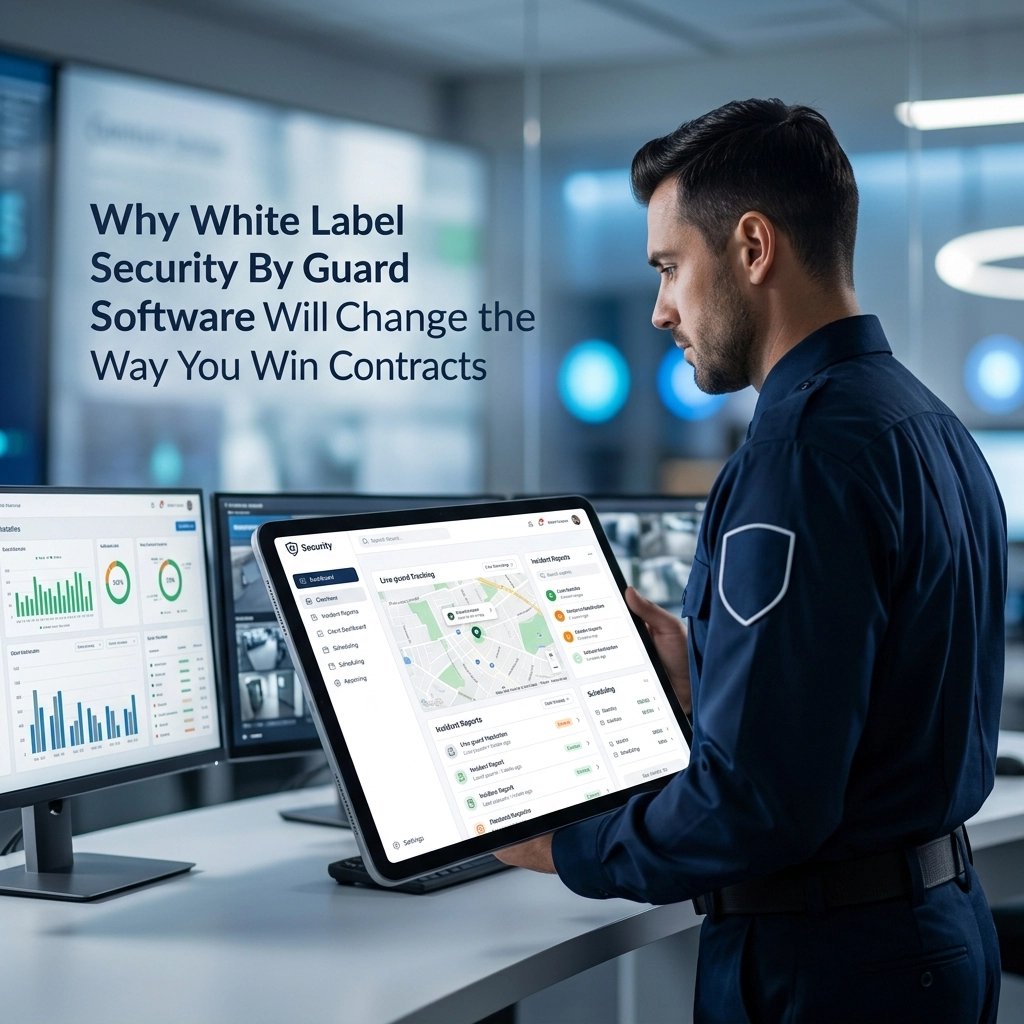
If you run a security company — whether you have 5 guards or 500 — the software you choose will either save you 15 hours a week or cost you your best clients. The market for security guard management software has exploded in 2026, and the options range from basic scheduling apps to full AI-powered operations platforms.
This guide covers everything you need to know: the must-have features, the key questions to ask vendors, a comparison of the top platforms, and how to calculate the ROI before you sign a contract.
What Is Security Guard Management Software?
Security guard management software is an operations platform that centralizes every aspect of running a security company — guard scheduling, GPS patrol tracking, incident reporting, client billing, and real-time alerts — into a single system accessible from any device.
The best platforms in 2026 go further: they use AI to automate incident reports, generate professional client-facing documents in seconds, and flag compliance issues before they become liability problems.
The 10 Must-Have Features in 2026
Before evaluating any vendor, verify these 10 capabilities are present. Missing even one can create operational blind spots that cost you contracts.
1. Real-Time GPS Guard Tracking
Every guard's location must be visible on a live map at all times. Look for geofencing that triggers automatic alerts when a guard leaves an assigned zone or misses a checkpoint. This is the single most important feature for client accountability.
2. AI-Powered Incident Reporting
Manual incident reports are the #1 source of billing disputes and client complaints. AI-assisted reporting tools take a guard's voice notes or brief text input and generate a professional, structured report in under 90 seconds. This feature alone saves the average security company 8–12 hours per week in administrative time.
3. Guard Scheduling and Shift Management
The scheduling module must handle recurring shifts, last-minute replacements, overtime tracking, and certification expiry alerts. Platforms that integrate scheduling directly with payroll eliminate the most common source of billing errors: timesheet discrepancies.
4. Client Portal with Real-Time Transparency
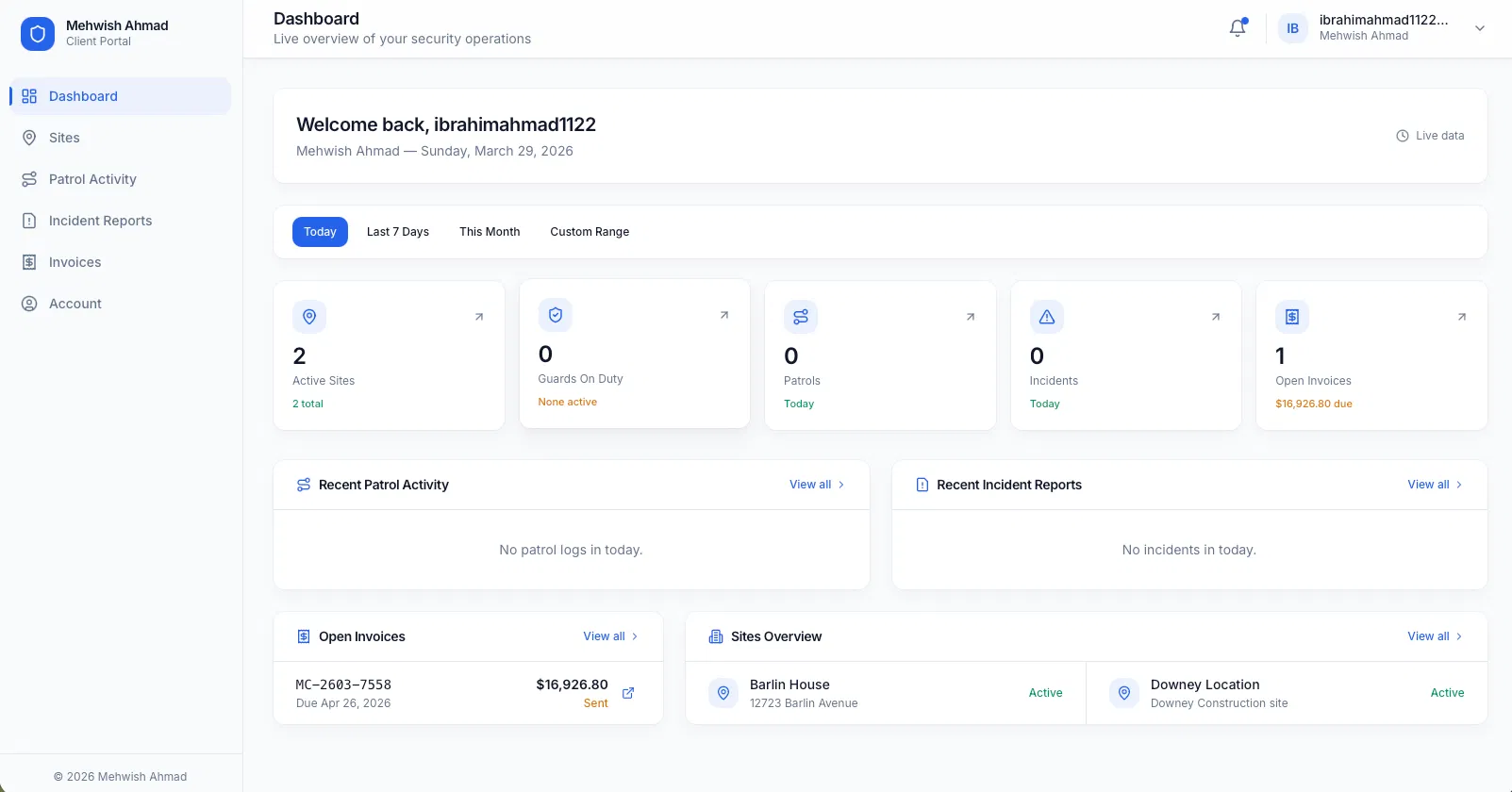
High-value clients — property management firms, corporate campuses, construction sites — expect a branded portal where they can log in and see patrol logs, incident reports, and active guard locations in real time. This feature is the single biggest differentiator when competing for premium contracts.
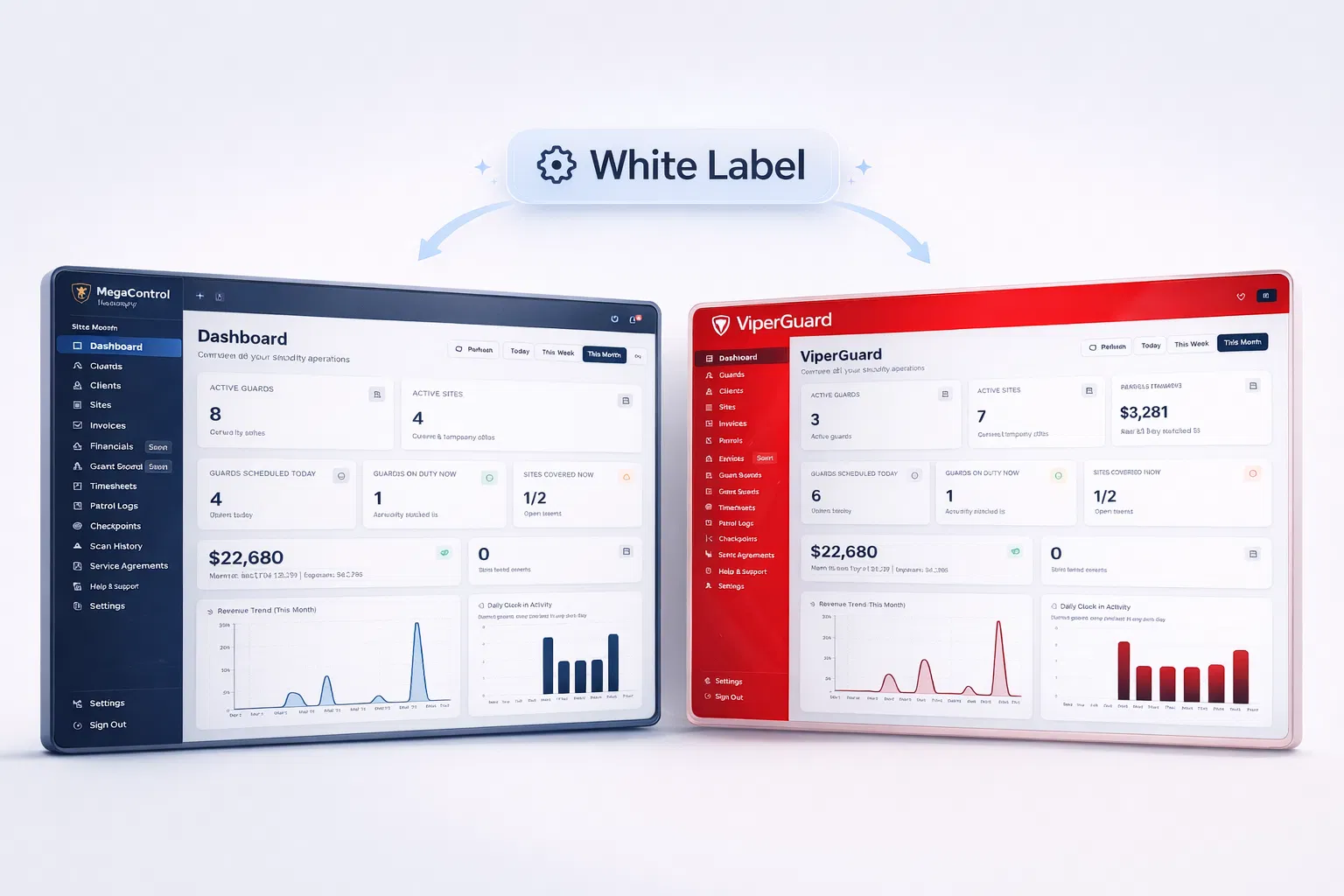
5. White-Label Branding
The best platforms let you replace the vendor's logo with your own across the guard app, client portal, and all generated reports. When a client sees your brand on every touchpoint, you are perceived as a technology company, not a staffing agency. This justifies 10–30% higher hourly rates.
6. Automated Billing and Payroll Integration
GPS-verified timesheets should flow directly into invoices with zero manual data entry. Platforms that automate this step eliminate billing disputes and reduce accounts receivable cycles from weeks to days.
7. Mobile Guard App (iOS and Android)
Guards need a reliable, easy-to-use mobile app for clock-in/out, checkpoint scanning, incident filing, and receiving post orders. The app must work offline and sync when connectivity is restored — critical for underground parking garages, warehouses, and remote sites.
8. Real-Time Alerts and Escalation Rules
Missed clock-ins, geofence breaches, and SOS activations must trigger instant notifications to supervisors via SMS, email, and push notification. Platforms with configurable escalation rules (e.g., alert supervisor after 5 minutes, alert manager after 10) reduce incident response times dramatically.
9. Compliance and Certification Tracking
Guard licenses, certifications, and background check expiry dates must be tracked automatically. Platforms that alert you 30, 60, and 90 days before expiry prevent the compliance violations that result in contract terminations and fines.
10. Reporting and Analytics Dashboard
Operational data — patrol completion rates, incident frequency by site, guard punctuality scores, overtime trends — must be available in a visual dashboard. This data is essential for quarterly client reviews and for identifying underperforming sites before clients notice.
Top Security Guard Management Software Platforms in 2026
The market has consolidated around a handful of serious platforms. Here is how they compare on the features that matter most to growing security companies.
| Platform | GPS Tracking | AI Reports | Client Portal | White Label | Starting Price |
|---|---|---|---|---|---|
| TrackGuard | ✅ Real-time | ✅ Full AI | ✅ Branded | ✅ 100% | $149/mo |
| TrackTik | ✅ Real-time | ⚠️ Limited | ✅ Yes | ⚠️ Enterprise only | $500+/mo |
| Silvertrac | ✅ Real-time | ❌ No | ⚠️ Basic | ❌ No | $200+/mo |
| Guardso | ✅ Real-time | ❌ No | ✅ Yes | ❌ No | $150+/mo |
| Novagems | ✅ Real-time | ⚠️ Basic | ✅ Yes | ⚠️ Partial | $199+/mo |
How to Calculate ROI Before You Buy
Every security company owner asks the same question: "Will this software pay for itself?" The answer is almost always yes — but the math differs by company size. Here is a simple ROI framework.
Time Savings
The average security company owner or operations manager spends 15–20 hours per week on manual tasks: scheduling, timesheet reconciliation, report editing, and client calls asking "did the guard show up?" A platform that automates these tasks at $149/month costs less than a single hour of your time per week.
Billing Accuracy
GPS-verified timesheets eliminate the billing disputes that cost the average 20-guard company $800–$2,000 per month in write-offs. A platform that pays for itself in recovered revenue in the first month is not a cost — it is a profit center.
Contract Win Rate
Security companies that present a branded client portal during sales pitches report a 20–35% higher contract close rate on competitive bids. One additional contract per quarter at $3,000/month in revenue represents $36,000 in annual revenue from a $1,800/year software investment.
The 5 Questions to Ask Every Vendor
Before signing any contract, ask these five questions. The answers will reveal whether the platform is built for companies like yours or for enterprise clients with dedicated IT teams.
- How long does onboarding take? The answer should be hours, not weeks. Platforms that require a 30-day implementation process are built for enterprise, not for growing security firms.
- Is white-labeling included in the base price or an add-on? Many platforms charge $200–$500/month extra for white-label features. TrackGuard includes 100% white-labeling in every plan.
- Does the mobile app work offline? If the answer is no, your guards will have gaps in their patrol logs every time they enter a building with poor signal.
- Can I export all my data if I cancel? Vendor lock-in is a real risk. Ensure you can export guard records, client data, and patrol history in a standard format.
- What is the per-guard pricing model? Platforms that charge per guard become expensive as you scale. Look for flat-rate pricing tiers that grow with your business without penalizing you for adding staff.
Why AI Is the Biggest Differentiator in 2026
The security software market has split into two categories: platforms built before AI and platforms built around AI. The difference is not cosmetic. AI-native platforms like TrackGuard fundamentally change what is possible for a small-to-medium security company.
AI-powered incident reporting means a guard who witnesses a trespassing incident can speak three sentences into their phone and receive a professionally formatted, legally defensible incident report within 90 seconds — complete with timestamps, location data, and suggested follow-up actions. The same report would take 20 minutes to write manually, and the manual version is almost always less accurate.
AI-driven scheduling optimization analyzes historical data to predict which shifts are most likely to have no-shows and proactively suggests replacements. This reduces the 3:00 AM phone calls that burn out operations managers and lead to high turnover.
Predictive compliance alerts scan all guard certifications and flag expiry risks 90 days in advance, giving you time to schedule renewals without disrupting coverage.
The Bottom Line: What to Look for in 2026
The security guard management software market in 2026 rewards companies that invest in platforms with three core capabilities: real-time GPS accountability, AI-powered reporting, and branded client portals. These three features directly address the three biggest pain points in the industry — missed patrols, unprofessional documentation, and client churn.
If you are evaluating platforms right now, the most important question is not "what does this software cost?" but "what does it cost me to not have this software?" For most security companies with 10 or more guards, the answer is $2,000–$5,000 per month in lost efficiency, billing errors, and missed contracts.
Ready to see how TrackGuard compares for your operation?
Start your 30-day free trial at TrackGuard.co — no credit card required, full white-label setup in under 10 minutes.